In Brookhaven, the Lot Line Matters More Than the List Price
September 24, 2026
September 24, 2026
A bungalow on Winding Lane in Ashford Park sold for $850,000 not long ago. It sat on close to half an acre with about 80 feet of frontage, a livable house that could also be expanded or replaced. Walk two doors down and you will find a torn-down rebuild on a lot roughly the same size, priced well over a million dollars higher. Same street, same zip code, same school assignment. The gap is not about granite counters or a finished basement. It comes down to a line most buyers never ask to see: where the stream buffer falls on the survey.
That is the detail that catches people off guard in Brookhaven right now. A buyer finds what looks like an underpriced lot, does the math on a teardown, and assumes the acreage on the listing sheet is the acreage they get to build on. Then a builder's due diligence period turns up a buffer running off a state water on the back third of the property, and the buildable envelope shrinks to something that no longer supports the $2 million house the pro forma assumed. The lot was never a bargain. It was a different product wearing a familiar price tag.
Brookhaven's median sale price sat at $799,000 for the three months ending June 2026, up 6.5 percent from the same period a year earlier. Zillow's separate home value index, updated at the end of July 2026, put the average closer to $753,500, up 2.9 percent over the year. Neither number is wrong. They are just measuring different things, one an index smoothed across the entire housing stock, the other a snapshot of whatever actually closed that quarter, and in Brookhaven right now that quarter is loaded with four distinct products getting averaged together.
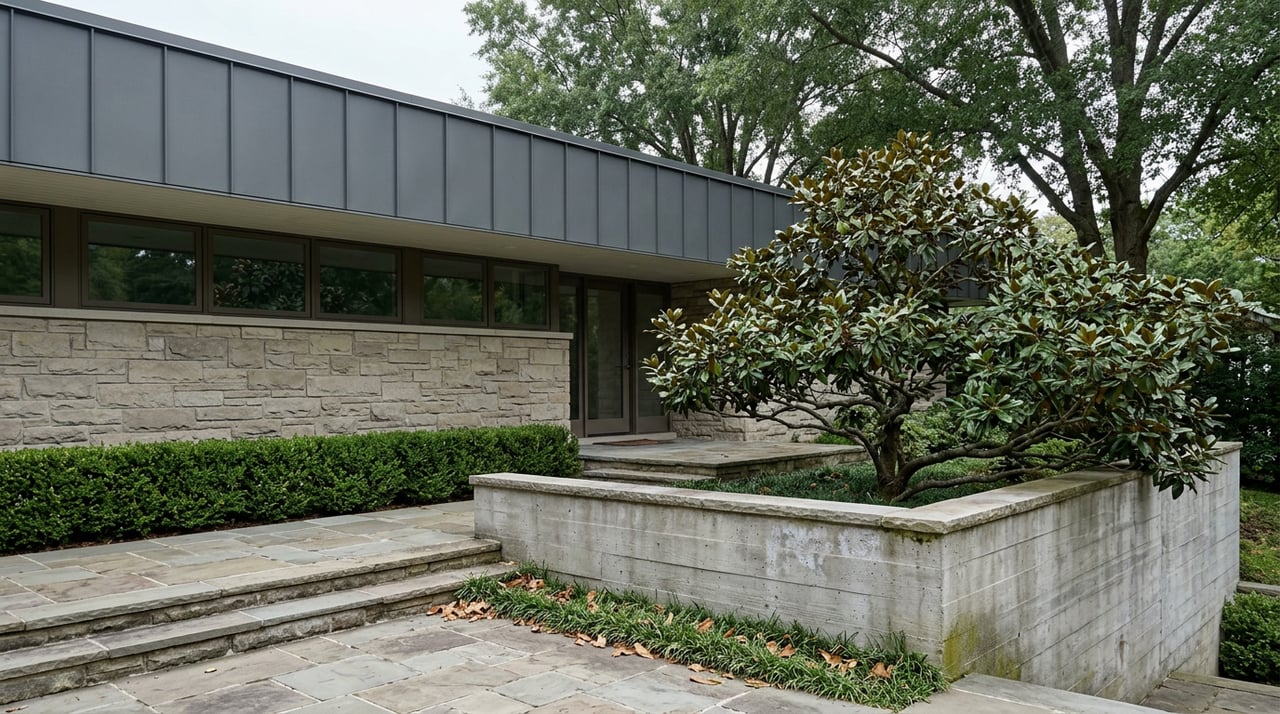
The first product is the original home on a lot that already fits its footprint, the kind of 1950s and 1960s ranch or bungalow you still find on Ashford Park and Drew Valley streets. The second is the rebuild, where a builder bought the same kind of lot for its buildable potential and put up something three to four times the square footage. Historic Brookhaven's estate corridor near Capital City Country Club and Peachtree Golf Club is its own tier entirely, with Zillow's neighborhood index for that stretch crossing $1.8 million as of the January 2026 snapshot, a number that has almost nothing to do with what a teardown costs a mile away.
| Segment | What you're actually buying | Rough 2026 range |
|---|---|---|
| Original ranch or bungalow, unrenovated | A house sized to its lot's original zoning, minimal remaining upside without a rebuild | Ashford Park/Drew Valley index in the high $800s to low $900s (early 2026 Zillow snapshot) |
| Teardown lot | Land value, priced against buildable envelope, not condition | $400,000 to $750,000 for the lot alone in Ashford Park or Brookhaven Fields |
| Rebuilt or new custom home | Finished square footage on a lot that cleared setbacks and buffers | Historic Brookhaven estate tier above $1.8M; Ashford Park rebuilds well above the city median |
| New attached infill | New construction without the land-value math | Mid-$600,000s to just under $700,000 |
Here is the part that decides which of those four rows a specific listing actually belongs to. Brookhaven's single-family zoning sets minimum lot size and minimum lot width by district, and those minimums, not the number on the listing sheet, cap how much house a parcel can legally support. A half-acre lot with narrow frontage does not automatically clear the same envelope as a half-acre lot that is wide and square. Add a stream buffer, and the constraint gets sharper. Georgia's rules protect a set distance around a state water, and where that buffer falls on a given parcel is not something you can eyeball from the street. It shows up on a survey, and it can eat enough of a lot's depth to change whether a rebuild pencils out at all.
Brookhaven's own planning documents flag the Ashford Park-Drew Valley character area specifically for the kind of infill redevelopment where larger homes are replacing older ones, which is exactly why that corridor has become the clearest teardown market in the city.
None of this shows up in a portal's median. It shows up in a plat and a buffer determination, which is exactly the paperwork worth pulling before anyone compares a specific address to a citywide number.
If you are the buyer looking at that original ranch instead of the teardown next to it, you are not really competing against the rebuild's finished price. You are competing against what it would cost to get your own house to that same finish line. Adding a second story to a 1950s ranch typically runs $400 to $600 per square foot in 2026, and that is before you account for Brookhaven's tree ordinance: a 2017 study measured the city's tree canopy at 53.6 percent of its land area, and Block Renovation describes a replacement requirement built around protecting it. Clearing mature trees for an addition or a rebuild is not a line item you skip. It is a cost that shows up before the framing does.
There is a county layer on top of the city process too. Brookhaven has run its own permitting since incorporating as a city in 2012, separate from DeKalb County, but DeKalb still performs a preliminary review for any sewer or water-line easement on a property. If an easement turns up, it triggers a full DeKalb Watershed Management review, which is its own timeline to plan around before anyone breaks ground.
None of that makes the renovated original a worse choice. It makes it a different bet, one where the upside is smaller but the path to it is faster and doesn't depend on a builder's ability to clear a buffer determination.
There is one more product in Brookhaven that sidesteps the lot math entirely, and it barely existed here a few years ago. A townhome infill project on Apple Valley Road, walkable to Brookhaven Village and the MARTA station, has been delivering new construction at a price point that competes directly with a renovated original rather than with a teardown rebuild. Units there launched in the mid-$600,000s, and by this summer the smallest remaining floorplans were still priced in the high $600,000s to just under $700,000, brand new construction, no yard to negotiate, no stream buffer to worry about, in a submarket where that combination barely existed before.
That is not a compromise product. It is a genuinely different way to get new construction in Brookhaven without winning a bidding war against a builder for a lot's buildable envelope.
If you are shopping Brookhaven right now, the median number you saw on a portal search is a starting point, not a verdict on any specific house. A few things worth confirming before you compare a listing to it:
Does a bigger lot always mean a bigger allowed home in Brookhaven? Not necessarily. Zoning minimums and any stream buffer on the parcel determine the buildable envelope, and a lot's total acreage does not tell you where that buffer falls or how much of the lot it removes from consideration.
Why would my agent bring up a stream buffer before we've even made an offer? Because a buffer determination can change the entire investment case for a teardown lot. Finding out after you are under contract, instead of before you write the offer, is the expensive way to learn it.
Is a torn-down rebuild automatically the better long-term buy compared to a renovated original? It depends entirely on whether the lot's buildable envelope, once zoning and any buffer are accounted for, actually supports the size and style of home that commands the premium. A lot that looks identical to its rebuilt neighbor on paper can be a much more constrained site once a survey is pulled.
Brookhaven rewards buyers who ask about the lot before they ask about the kitchen. If you are trying to figure out which of these four Brookhaven markets a specific address actually belongs to, or you are sitting on an original home and want to know what it is really worth against the teardown activity on your street, Ginger Pressley can walk the zoning and the comps with you before you write an offer or set a list price.
This article is general information, not legal, tax or financial advice. Consult a qualified professional about your situation.
Stay up to date on the latest real estate trends.

For anyone looking to dip their toe into the real estate market, broaden their asset portfolio, or build wealth in real estate, reach out to Ginger to start your journey.